
A Conversation with Shereen Bhan, Senior Director for Leadership Development and Learning – WomenLift Health
The WomenLift Health Global Fellows community is growing with every cohort. These are mid-to-senior women leaders returning to their institutions, their governments, and their communities with something new. What are you seeing, are the numbers starting to translate into real change in health systems?
What I see most clearly is a shift in the questions our Fellows bring back to their institutions. Where they once might have asked how to solve the problem in front of them, they now ask what in the system is producing it, and who else needs to be in the room.
In East Africa, Dr. Masika Sophie advised the Africa Group through the Pandemic Treaty negotiations and worked to embed One Health into the treaty’s core framework. The treaty now includes an article on One Health and prevention, a shift she helped make possible. In South Sudan, Dr. Idyoro Ojukwu, the country’s only gynecological oncologist, had a direct conversation with the Ministry of Health’s Director General that led to the commission of the country’s first cervical cancer screening guidelines, which she developed with WHO and used to train 25 providers. And in India, Dr. Kanica Kaushal leveraged a relationship forged through the Leadership Journey to secure a ₹12.7 million funding partnership, extending early detection of fatty liver disease to ten additional states and millions more people.
These are not small moves by individuals. These are mid-to-senior leaders with the capacity, credibility, and network to move systems, which is why the change rarely stops with one person. It carries into every team they build and every policy they shape.
The landscape of global health leadership is shifting, AI, climate change, and emerging pandemics. These are challenges that no single discipline or institution can address alone. How is the WomenLift Health leadership journey preparing women leaders for that complexity?
These women already lead in complexity, running national programs, negotiating treaties, and building systems where none existed. They are selected because they’re exceptional leaders, and the Journey changes how they lead.
The world is smaller and more connected than it was, and challenges like AI, climate change, and the next pandemic cut across disciplines, sectors, and borders. These problems call for collective ownership and collaborative solutions. Leading here means working through influence, convening people who do not usually sit at the same table, and holding steady when the evidence, the funding, and the politics are all moving at once. Two of the competencies the Journey enhances are made for exactly this: leader agility and an ecosystem mindset. The first is the capacity to lead change when conditions keep shifting; the second, the ability to see and move a whole system rather than a single institution. Together they equip a leader to drive change she cannot fully control, and to do it alongside others.
You can see it in what Fellows do. Dr. Folake Olayinka helped shape and operationalize the largest bilateral investment in global vaccine equity in history, a $5 billion effort reaching more than 100 countries, aligning experts across agencies. Dr. Margaret Mutumba leads more than 20 research and innovation collaborations spanning maternal health, pandemic preparedness, public health surveillance and AI, and works to bring community and partner priorities into conversations with major funders and decision-makers. Both lead through influence and relationship building across institutions. That outreach is the ecosystem mindset in practice.
Leadership like theirs shapes systems, but systems are never neutral about who they reach. That is something we hold deliberately. Left unattended, AI and climate change will deepen the inequities our systems already carry. As Kelly Zongo, one of our Fellows, puts it, “if you just build the systems, and you’re not deliberate about making sure that women or marginalized people have access to those systems, you risk exacerbating those inequalities.” In the Journey we treat who benefits and who is excluded as a leadership question, every time.
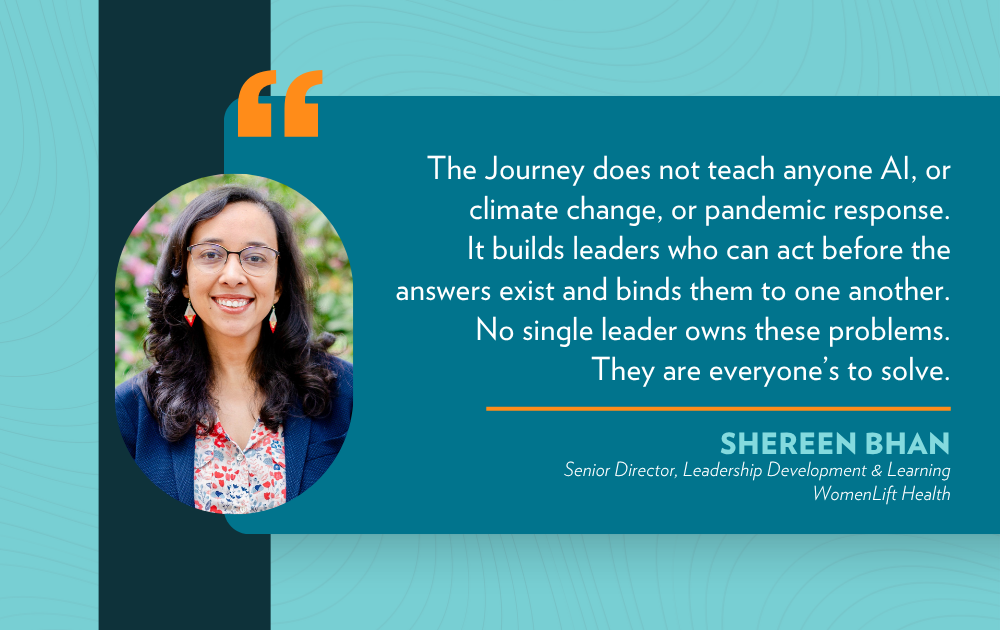
The Journey does not teach anyone AI, or climate change, or pandemic response. It builds leaders who can act before the answers exist and binds them to one another. No single leader owns these problems. They are everyone’s to solve.