
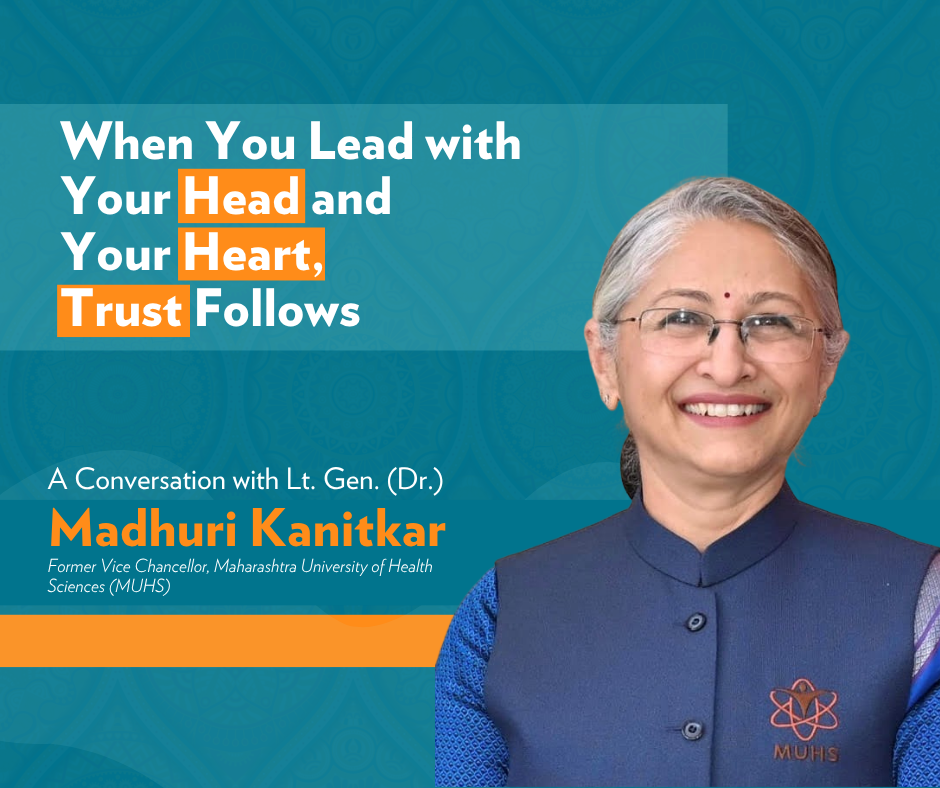
A Conversation with Lt. Gen. (Dr.) Madhuri Kanitkar, Former Vice Chancellor, Maharashtra University of Health Sciences (MUHS)
What drew you to becoming Vice Chancellor at MUHS, and what did you find when you arrived?
I had an extremely rewarding career in the armed forces, retiring as a Lieutenant General, with deep experience in both clinical leadership and administration. I served on the Prime Minister’s Scientific Technical Advisory Committee and the Board of Governors for the Medical Council of India. What really affected me was the changing scenario of the medical profession, I felt it was ailing, and someone needed to treat it. When I felt I was in a position to do something, I thought I must jump in. When I arrived at MUHS, I found there was not a single woman in any statutory post, no Pro-VC, no Registrar, no Controller of Examinations. And yet female student enrolment was 50–60% across most streams, and 80% in nursing. They started with such an advantage but were hardly present in any decision-making role. That bothered me deeply.
What resistance did you encounter as a woman leader, and how did you navigate it?
When I applied for the post, some people asked me if my husband was okay with the idea.That amused me. I answered that I never find it a challenge, and my husband has always supported me, so I don’t need to take permissions. Inside the university, the resistance was constant. Whenever I tried to bring about change, in the examination system, evaluation, appraisal, inspections, the response was: “This is not how it’s done. The university has been here for 25 years.” When I promoted women to academic roles, by merit, opponents would not resist me directly, but they would make things difficult for the women themselves. My approach was to rule with my head but lead with my heart. I got to know individuals, listened to their problems, took their HR issues to government level and got them resolved. I organized treks and picnics well beyond my role as Vice Chancellor. That dual approach-built trust, and a slow transformation started showing results.
What is the real impact of women leading institutions like MUHS?
Women bring unique qualities to leadership, empathy, the ability to multitask, and a particular blend of head and heart. But more than that, you become a role model. Young women watch you and think: if she can do it, I can do it. That internal awakening, that aspiration is enormous. I saw women walk up and say, “We thought this was impossible, but if you could do it, we can.” That kind of self-confidence that emerges from watching another woman achieve makes it a little easier for the next generation to follow. You create a pipeline. Within a year or two of my tenure, 80% of our academic departmental leadership roles were filled by women, because they simply needed that little catalyst in the form of mentorship. Women leaders must actively take interest in promoting other women. If a path has been laid for you, your job is to lay it for those who come next.
What do you see changing globally for women in health leadership and what would you say to women navigating these challenges today?
I am seeing real change. In India, the Secretary for Health is a woman. The Commissioner for Public Health in Maharashtra is a woman. When I sat on the WHO’s Scientific Technical Advisory Group for Integrative Health, I looked around that table and saw women from across the globe, not as tokens, but as substantive contributors whose achievements were phenomenal. But we must now move out of tokenism into true inclusivity. That means not just having women in numbers, but giving them equitable opportunities to train, to access grants, to lead research, to have a real say. To women navigating this: a woman needs to be her own challenge. Do not wait for someone else to challenge you. If you stand up with confidence, with competence, and the courage of conviction, no one can stop you.