
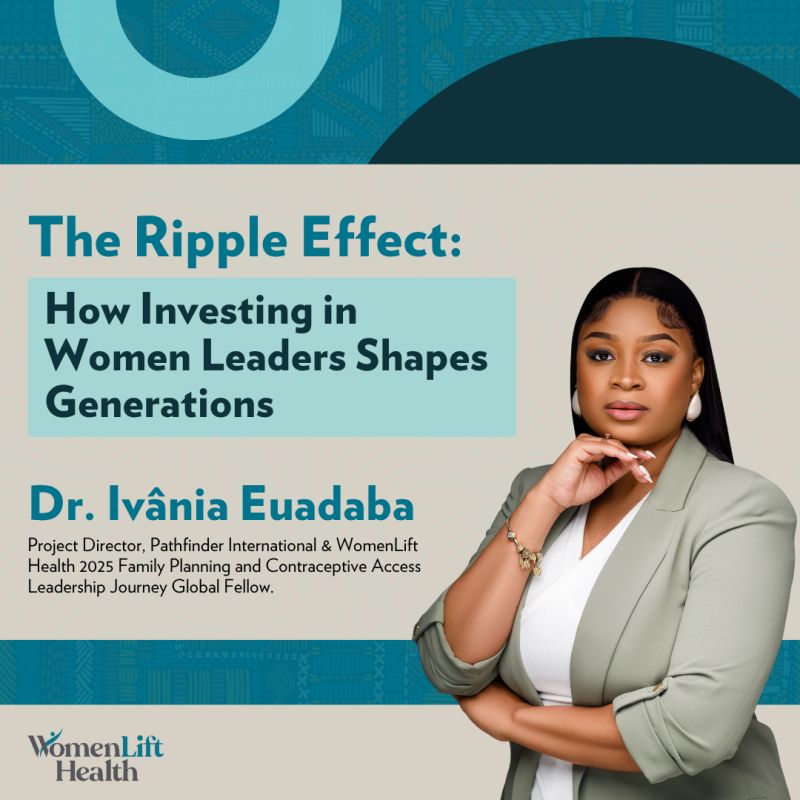
As we come to the end of this Women’s History Month, we are celebrating leadership that leaves a legacy, not just in health systems, but in homes. As part of our 2025 Family Planning and Contraceptive Access Leadership Journey, our Global Fellow, Dr. Ivânia Euadaba, project director at Pathfinder International discovered that the most profound evidence of her growth as a leader was not found in a conference room or a policy brief, it was found in her daughter, who watched her mother walk her path with intention and quietly decided to walk her own.
In this Q&A, Dr. Ivania shares her story in her own voice, the sacrifices, the breakthroughs, and the moment she realized that investing in women leaders creates a ripple effect far and wide. Her story is for every woman who has ever wondered whether leading with purpose and paying it forward is truly worth it. It is. And the proof is in the next generation.
How has the Leadership journey equipped you to show up better?
The leadership journey equipped me to show up not only more authentically, but with a deeper understanding of what leadership truly demands. It taught me that leadership is not just about taking up space – it is about creatingspace for others. A true leader builds legacies, not just careers. And that requires intentionality: knowing when to step forward, when to step back, and how to ensure that the doors we walk through remain open for those coming behind us.
One of the most transformative exercises was the mirror work: the discipline of looking at myself honestly and asking not only “How do I see myself as a leader?” but “How am I perceived by others?” That gap between intention and perception had to be examined. It pushed me to confront hard truths about how I showed up, when I held back, and where I needed to be more present and more positioned (particularly on social media), where I now use my voice more intentionally to amplify the impact of my work and advocate for SRHR-family planning and adolescent health.
This journey also named something I had felt for years but never voiced: the imposter syndrome. It equipped me to recognize it, call it by its name, and challenge it not as a flaw, but as a signal that I was stepping into spaces where I belonged but hadn’t yet fully claimed. Becoming aware of it was the first step. Choosing to speak and act.
Beyond individual growth, the journey strengthened me through a powerful network of women who support women, a sisterhood of leaders across Africa and beyond, working toward synergistic results in global health. These relationships have become my anchor, reminding me that I am not alone in this work and that our collective power far exceeds what any of us can achieve individually.
Most importantly, this journey taught me to lead with purpose and courage, especially in times of uncertainty. Whether navigating funding shocks, shifting political landscapes, or the personal challenges of balancing motherhood and leadership, I now move forward with a clearer sense of why I do what I do and the courage to keep going, even when the path is not clear.
So yes, I learned to show up as myself. But more than that, I learned to show up with clarity, connection, and conviction. That is the equipment I carry with me now.
What shifted in you during those 12 months in the leadership journey and when did you first notice it?
The first shift happened quietly during one of the early coaching sessions. I was asked a simple question: “What do you believe you deserve?” And I realized I had spent years proving myself to rooms that already owed me a seat.
What shifted was my internal compass. I stopped leading to convince and started leading to contribute. The second shift I noticed was how I listened – not to respond, but to truly hear. And third, I began to see leadership not as a position to occupy, but also as a condition to create spaces so that others could flourish.
I first noticed it when I stopped apologizing for my ambition. When I began mentoring my supervisees not to copy me, but to become themselves. And when I understood the power offeedback (formal and informal).
You mentioned navigating the challenges of being a young mother who refused to give up on her dreams. How did the Leadership Journey help you hold both of those identities—mother and leader—without choosing between them?
For a long time, I believed that being a good mother meant sacrificing parts of my ambition. And being a good leader meant leaving parts of my motherhood at the door. This journey dismantled that! It helped me see that my children—my daughter and her three siblings — were not distracted from my purpose. They were partof it. The leadership journey gave me understanding that leading with intention at home and in public are not separate acts. They are the same act of love.
The journey dismantled the myth of work-life balance and introduced me to a more truthful concept: work-life harmony. Balance suggests a perfect equilibrium that is impossible to sustain. Harmony, on the other hand, acknowledges that different parts of my life will require different rhythms at different times, and that is perfectly okay.
I became conscious that I am the one who integrates both lives. Not the calendar, not the job, not society’s expectations—but me. I decide when to lean into motherhood and when to lean into leadership, knowing that both are always present, always shaping each other.
And the evidence is walking beside me. My teenage daughter has become a young woman with strong convictions about the need to advocate for the inclusion of girls and women in decision-making spaces. She is proof that when we lead with integrity at home and in the world, our children don’t just survive our ambition—they inherit it.
You wrote that your daughter has watched you occupy decision-making spaces, mentor your direct reports, and fight for adolescents and women to access contraception and family planning. Were you conscious of her watching or did you only realise the impact in retrospect?
I was not conscious of her watching. But over the past few months, I have watched her step onto international stages at just 16 years old. I have seen her earn certificates of honor for excelling in her student community, dedicate herself to volunteering, and above all weave into her speeches and representations of themes I have spent my career fighting for – the importance of integrating girls and women into decision-making spaces.
It was in these moments – reading her essays, watching her advocate on behalf of her community, seeing her name recognized across borders – that I realized that she had been absorbing everything. Not the speeches I gave. Not the titles I collected. But the quiet resilience and the way I kept showing up, even when it was hard.
She didn’t learn leadership from what I said. She learned it from what I did. And today, she is not just my daughter. She is a young woman with strong convictions, using her voice to open doors for other girls, just as she watched me try to do.
What is the one thing you hope other women in the WomenLift Health community take from your story, especially those who are also mothers trying to lead in both worlds at once?
I hope they take this: You are not failing.
Your children are not counting the hours you were absent. They are counting the moments you were present. And more than that, they are watching how you live.
When you fight for what you believe in, you are teaching them to fight. When you fall and get back up, you are teaching them resilience. When you lead with integrity, you are teaching them what character looks like.
You don’t have to choose between being a good mother and being a great leader. You just have to be honest—with yourself, with your children, with your teams—about the beautiful, messy, glorious reality of trying to be both. That honesty is enough.
And if you ever doubt it, look at the children watching you. They are not waiting for you to be perfect. They are waiting for you to be real. And that reality is the greatest leadership lesson they will ever receive.
Dr. Ivânia Euadaba is the Project Director, Pathfinder International and 2025 Family Planning and Contraceptive Access Leadership Journey Global Fellow.