
At Tanzania’s National Institute for Medical Research (NIMR), seven centres operate across the country, generating the evidence that informs national health decisions. When research centres underperform, the gap is not just institutional, it affects policies, health programs, and the communities that depend on that evidence.
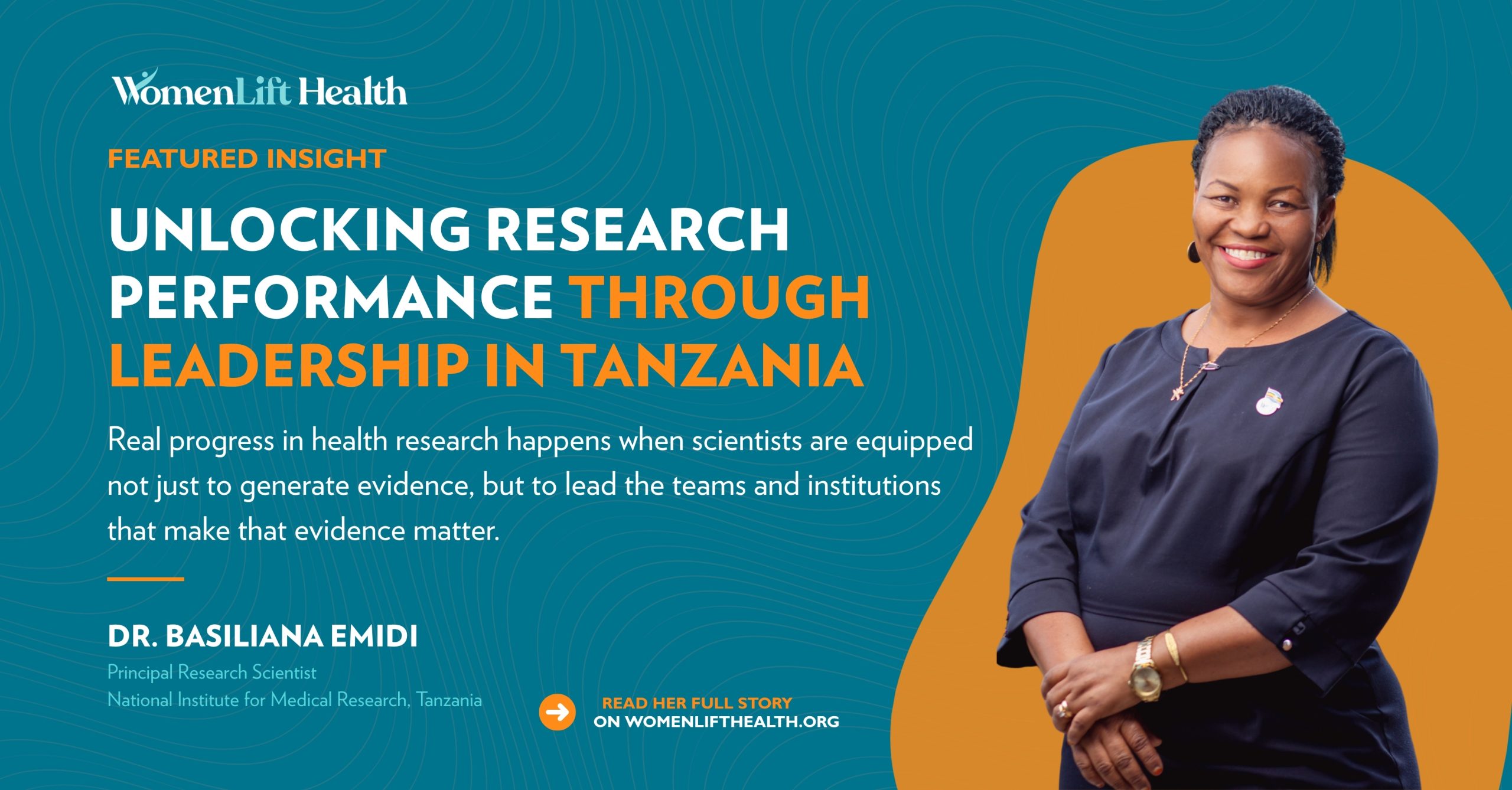
Dr. Basiliana Emidi is a medical entomologist whose research focuses on vector-borne diseases like malaria and dengue. She has spent years building evidence for community-based approaches to vector control, including a study exploring how women in endemic areas can become frontline champions in protecting their communities. When she was appointed Centre Manager at NIMR’s Dodoma centre in March 2024, the same time she completed the WomenLift Health Leadership Journey, she inherited a centre with only two publications.
Through the Leadership Journey, Basiliana gained the tools to meet this challenge. Coaching helped her move past perfectionism and imposter syndrome. She stopped waiting for conditions to be ideal and started asking what her team could produce with what they already had. She also learned to map talent deliberately, identifying different team members’ strengths and building processes that leveraged those strengths. “Before the leadership journey, I knew how to lead research,” she reflects. “After it, I know how to lead people.”
Basiliana applied that shift immediately. She embedded a team-based approach to research outputs, aligning scientists around shared goals and coordinating strengths. She prioritized deliverables and made herself part of the process rather than above it. For the past two consecutive quarters, the Dodoma centre became the leading contributor of publications across the entire institute, despite having the smallest team. Five staff she managed have been promoted; among them, three were scientists, thanks in part to the increased research output they had generated together.
The results did not go unnoticed. Three other centre managers came to ask how she had done it, and one invited her to address his team. She is the only woman leading a NIMR centre. “This journey – the WomenLift Health Leadership Journey, has been very transformative to me, it has given me confidence to lead,” she says, “to see myself not just as a scientist, but as someone who can shape the future of health research in Tanzania.”