
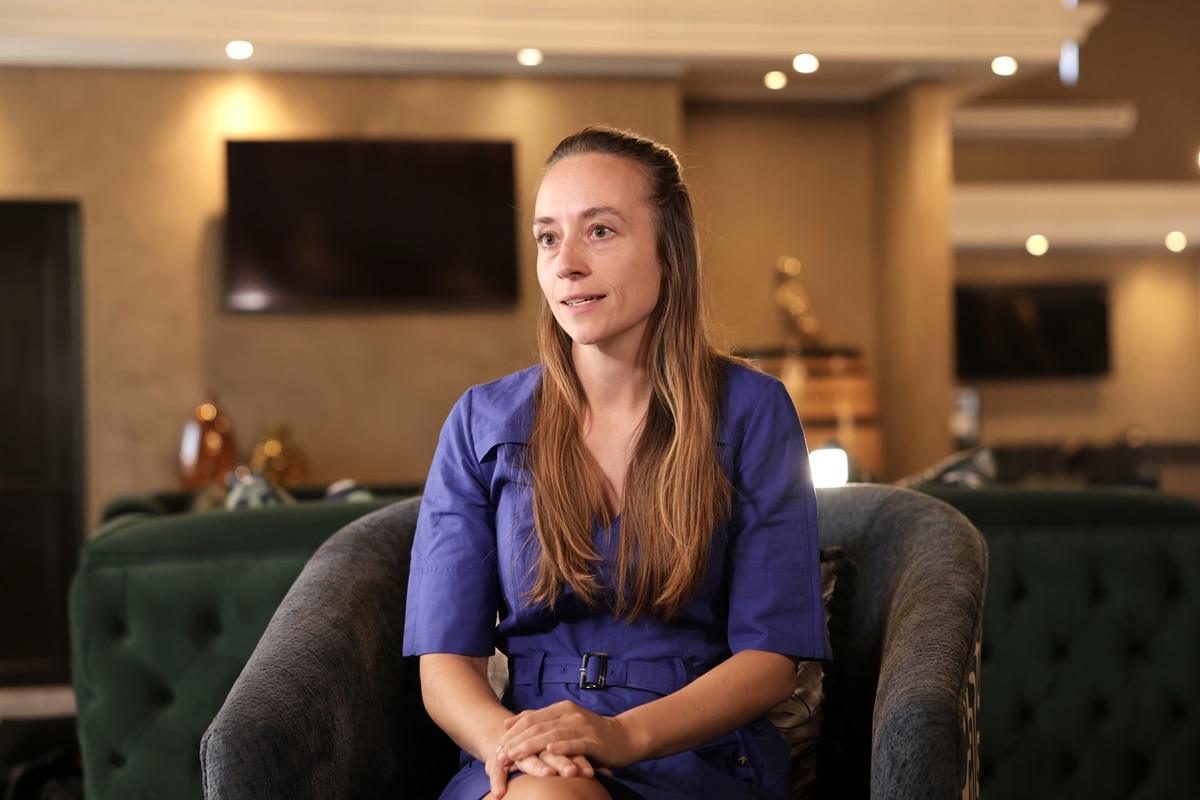
A World Microbiome Day conversation with Dr. Anna Ursula Happel
As the world celebrates the vital role microbes play in human health and across the planet, we found time to sit down with Dr. Anna Ursula Happel, WomenLift Health Global Fellow and Senior Research Officer at the University of Cape Town and academic leader of the Microbial Interactions Lab, one of the few platforms on the continent dedicated to African-led microbiome research.
The microbiome, that vast community of bacteria, viruses, and fungi, is rapidly emerging as one of the most exciting frontiers in health today. In this conversation with Dr. Happel, we explore how representation truly forms both a scientific and justice imperative in research, what her lab is uncovering about women’s health and infectious disease, and how placing African women at the very centre of microbiome science truly could transform health across generations.
 Dr. Happel, you lead the Microbial Interactions Lab at the University of Cape Town, a platform specifically designed for African-led microbiome research. What gap in the global scientific landscape made this lab not just useful but necessary?
 The Microbial Interactions Lab addresses a critical gap in biomedical research: the severe underrepresentation of African microbiomes in global studies and reference datasets. This matters because microbiome composition is crucially informed by geography, diet, and life experiences, factors that make findings from high-income countries not easily applicable to African populations.
Our laboratory provides the infrastructure and expertise needed to investigate host–microbe interactions that influence health across the life course, with a particular focus on women’s health and infectious disease susceptibility. Importantly, it enables African-led research that generates locally relevant evidence and helps ensure that scientific advances are equitable and globally representative.
For many people, the thought of microbiomes relates to the world of probiotic yogurt advertisements. Science is, however, so much deeper. Can you tell us more about what this actually is and how this relates to women’s health?
The microbiome refers to the community of microorganisms, not only bacteria but also viruses, fungi, and others, that live in and on our bodies. These microbial communities play essential roles in gut health, immune regulation, and protection against infection.
For women’s health, the microbiome is particularly important. For example, the vaginal microbiome acts as a key line of defence against infections, including HIV and other sexually transmitted infections. Disruptions to these microbial communities can increase susceptibility to infection, influence pregnancy outcomes adversely, and affect longer-term health. So, the microbiome is not just about gut health, but it is central to overall health and disease risk.
African women carry a disproportionate burden of conditions linked to the vaginal microbiome. What does it mean, practically, when the science does not reflect the people it is meant to serve?
When science does not reflect the populations, it is intended to serve, it creates blind spots. Diagnostics, treatments, and prevention strategies may be less effective because they are based on incomplete or non-representative data.
In practical terms, this means that African women may not fully benefit from advances in microbiome science. For example, what is considered a “healthy” microbiome in one population may not apply in another. Without locally relevant data, we risk misclassifying health and disease and missing opportunities to develop interventions that are truly effective in African settings.
World Microbiome Day celebrates the vital role microbes play in human health and the planet. From where you sit, leading one of the few African-focused microbiome research platforms on the continent, what do you think the global microbiome science community most needs to understand or act on differently?
I think one of the biggest things the field needs to recognize is that who we study and who leads the research really matters. Right now, microbiome science is still heavily skewed towards populations in the Global North, which means we’re missing a big part of the global picture.
In our recent work, we highlight how this imbalance can lead to findings and interventions that don’t translate well to other settings, especially in Africa, where both microbial diversity and disease burden are high, but data are still limited. https://pmc.ncbi.nlm.nih.gov/articles/PMC13054970/
So, what needs to change is a shift towards more locally led, inclusive research. That means building capacity, supporting African scientists, and designing studies that truly reflect the populations they’re meant to serve. In the long run, that’s not just about equity; it is about doing better, more accurate science.
What would it mean for African women’s health if the microbiome research being conducted at your lab and others like it translates into diagnostics and therapeutics that are designed for African populations?
It would be transformative. It means moving towards diagnostics and treatments that reflect the biology of the populations they’re meant to serve.
Take bacterial vaginosis (BV), for example, a condition that disproportionately affects African women. The current standard of care is still antibiotics, which haven’t really changed in decades and are associated with high recurrence rates. Our recent work, jointly led by researchers from South Africa and the United States, is now showing that live biotherapeutics using beneficial bacteria to restore a healthy microbiome could help break that cycle by improving long-term microbial balance rather than just treating symptoms. https://pubmed.ncbi.nlm.nih.gov/41856107/
If these kinds of interventions are developed using data from African populations, they’re much more likely to be effective. That could reduce the burden of infections like BV and, in turn, lower risks for HIV, improve pregnancy outcomes, and support overall reproductive health. More broadly, it shifts the narrative from African women being underrepresented in research to being at the centre of innovation.
Beyond the science you lead, you are deeply committed in mentoring the next generation of African scientists. How does this work within the lab?
I remain deeply committed to supporting young women throughout their PhD studies – and advancing early career female scientists. In practice, this means meeting regularly with my mentees and providing thoughtful, individualized guidance that addresses both their academic and personal development. I also actively encourage them to build leadership skills and to think beyond the boundaries of their immediate research projects.
Mentorship in the lab is deeply hands-on and holistic in its approach. The experience covers both technical elements and critical thinking whilst also giving way to young scientists forming their own research questions and emerging as independent leaders. Just as important, the trainees feel deeply supported and confident in contributing ideas.
I adopt an intentional yet approachable, supportive and respectful style of mentoring, an aspect I take great pride in. The same depth of mentoring allows me to pass on more than scientific excellence. There is also a strong commitment to collaboration, integrity, and genuinely meaningful, relevant research. Building the next generation of scientists truly is just as important as the scientific efforts themselves.
Finally, what is the one thing you would want every African woman to know about the microbiome and its relationship to her health?
Your microbiome is a powerful and essential part of your health it plays a key role in immunity, metabolism, and reproductive wellbeing, across your lifespan. These microbial communities are shaped by everyday factors like diet, lifestyle, environment, and healthcare choices, meaning small changes can have a meaningful impact.
African women remain underrepresented within microbiome research. This means much more remains to be learnt about what optimal health looks like in our contexts. This makes it especially important for African women to be aware, informed, and included.
Understanding and caring for one’s microbiome is an act of empowerment recognizing these “invisible soldiers” as central to one’s wellbeing and health experiences. It is this very awareness that truly matters for the health and wellbeing of future generations of women.