
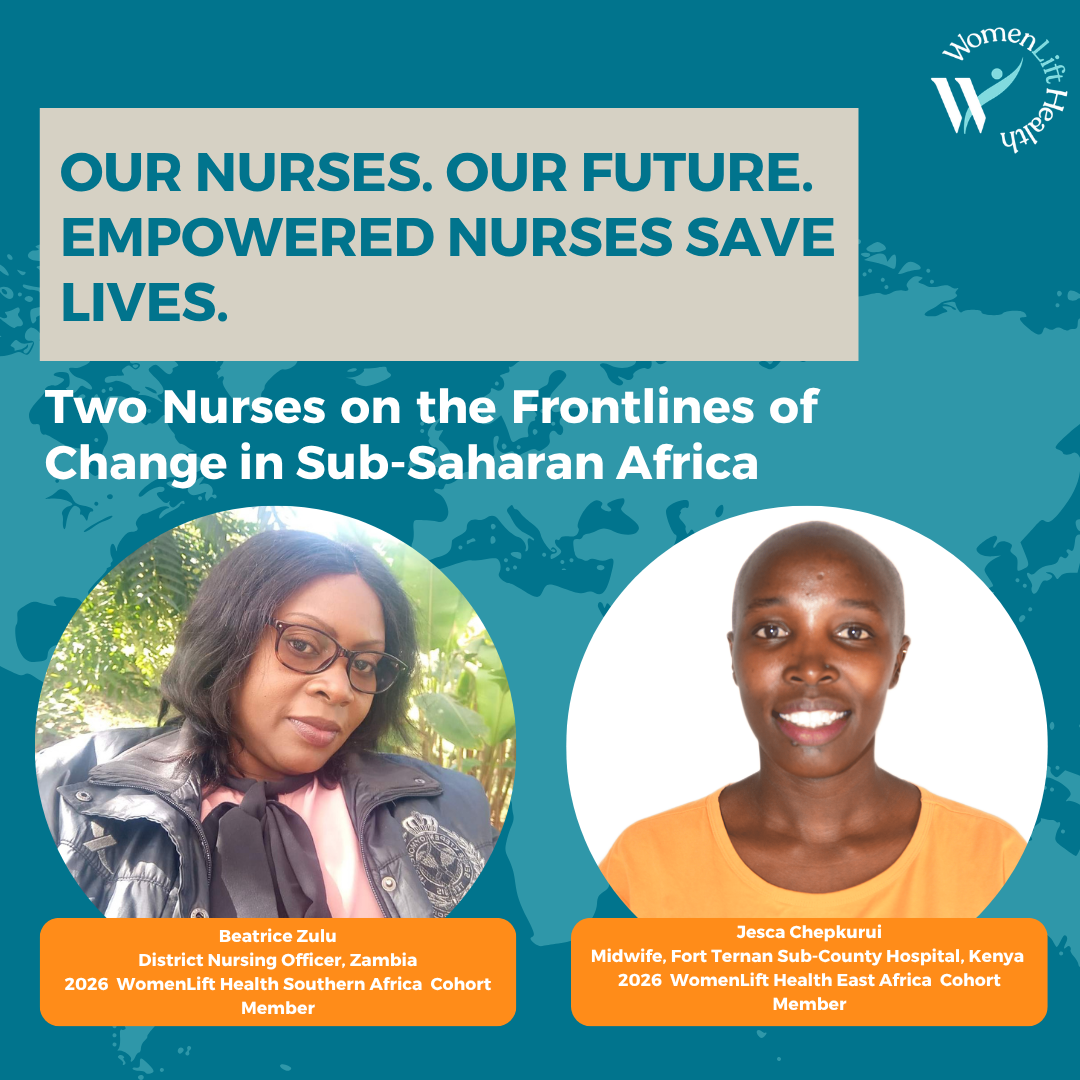
Two Nurses on the Frontlines of Change in Sub-Saharan Africa
Global health faces unprecedented pressure from chronic workforce shortages, rising healthcare demands, and the compounding effects of conflict and climate change. Nurses, the largest professional group in the global health workforce, continue to sustain care and hold fragile health systems together, often under immense strain and with limited resources. Yet their work remains chronically underrecognized, underfunded, and under-supported.
On International Nurses Day 2026, we spoke with two of our WomenLift Health Leadership Journey Cohort members: Beatrice Zulu, a District Nursing Officer in Zambia, and Jesca Chepkurui, a Midwife at Fort Ternan Sub-County Hospital in Kenya. Together, they illuminate the enormous power nurses hold to make healthcare safe, effective, and accessible to all, and why systemic investment in that power is long overdue.
The global nursing workforce faces a projected shortfall of millions over the coming decade, with sub-Saharan Africa among the most affected regions. What are the consequences for communities, particularly women, children, and those in remote or underserved areas?
Beatrice: When there are not enough of us, the impact is felt everywhere. Women miss antenatal care, children miss their immunizations, and families in remote areas go without skilled support during emergencies. Communities also lose access to chronic disease management, mental health services, and everyday preventive care that keeps people well. This is not simply a staffing issue; it is a barrier to achieving universal health coverage.
Jesca: The consequences are real and visible. One nurse to multiple critical patients. A baby needing resuscitation while another mother is in pain. During those moments, it is not only about workload, but also about life and death.
As District Nursing Officer for Chikankata, you lead strategic planning and quality improvement across multiple facilities. What have you learned about building and sustaining a nursing workforce in underserved areas?
Beatrice: Resilience is not just about numbers; it is about systems that nurture and protect nurses. Supervision should build confidence, not criticize. When nurses are supported with resources and professional development, we truly become the backbone of community health, whether in maternal care, infectious disease prevention, or health education.
You provide maternity care across antenatal, intrapartum, and postnatal settings. What does supporting a mother through that entire continuum reveal about the irreplaceable role of nurses and midwives?
Jesca: Maternal health is a continuum that starts long before labor and continues long after delivery. At each stage, there is a need for clinical expertise and emotional engagement. Antenatally, we detect risk factors like hypertension and anaemia before birth even begins. During labor, we make rapid clinical decisions, often in emergencies with limited resources. After birth, we support breastfeeding, monitor complications, and provide newborn care during those first critical hours.
One case stays with me: a mother arrived with obstructed labour following a delayed referral. There was no time to hesitate. Rapid assessment, team coordination, and emergency intervention saved both mother and baby. That moment captures something essential; nursing is often the foundation of survival.
You have pioneered youth-friendly health services and equity-focused maternal and child health interventions. How does nursing leadership translate into tangible outcomes for women and girls?
Beatrice: I have seen firsthand how nursing leadership makes a difference. We have expanded youth-friendly services, strengthened maternal and child health, improved malaria prevention, and engaged communities in shaping their care. When nurses lead, health systems respond better, and communities thrive.
You have pursued advanced training in POCUS, EmONC, ALSO, and Magnesium Sulphate administration. How has continuous professional development shaped your practice?
Jesca: Advanced training has profoundly changed how I deliver care. These skills help identify complications earlier, accelerate clinical decision-making, and enable more confident emergency management. They have also reinforced something important: nursing is not a one-size-fits-all profession defined by minimum qualifications. It has real potential for leadership, innovation, and system change when nurses are given the opportunity to grow.
With both clinical grounding and a Master of Public Health in Global Health, how do you see nursing evolving at the policy and systems level?
Beatrice: Nursing must be recognized as a strategic partner in policy. We bring frontline realities into governance, and those insights are essential for building effective, equitable health systems. Career progression must be clear and gender barriers dismantled, so nurses, especially women, can take their rightful place at the decision-making table. Investing nurses invests in equity, resilience, and universal health coverage.
What does genuine nurse empowerment look like in practice, and what structural barriers continue to stand in the way?
Beatrice: Empowerment means safe working conditions, fair pay, and real opportunities to grow. With access to training, mentorship, and leadership roles, nurses innovate and deliver better care. Yet underfunding, poor infrastructure, and gender inequities continue to hold us back.
Jesca: Investing in nurses is investing in health systems. Safe staffing is a critical quality measure, not a luxury. Nurses must also have a seat at policy tables. Without frontline voices, health systems lose touch with the realities of patient care. And the working environment matters deeply: burnout and understaffing do not only affect nurses. Their impact is felt directly by patients and families.
How every mother survives childbirth, how every newborn draws their first breath; these outcomes are, in no small part, a reflection of nursing. The question is whether we will empower or overburden the workforce that makes it possible.