
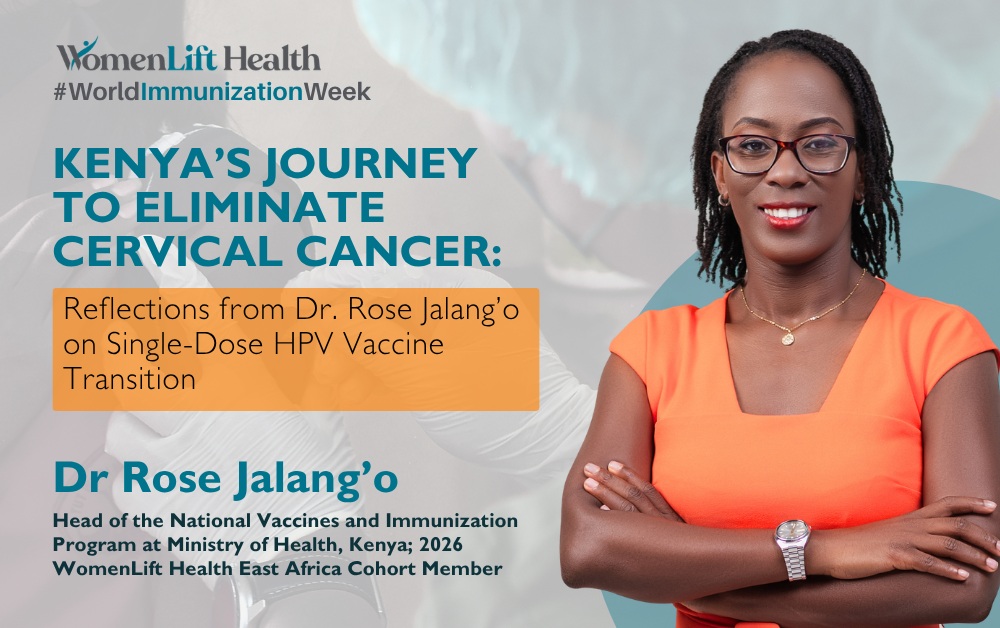
Every vaccine given today writes a promise to tomorrow. As the world marks World Immunization Week 2026 under the theme “For every generation, vaccines work,” Kenya stands at a pivotal moment in its public health journey. Cervical cancer remains the second most common cancer among Kenyan women, claiming nearly 3,600 lives annually. We spoke with Dr Rose Jalang’o, Head of the National Vaccines and Immunization Program at the Ministry of Health and our 2026 WomenLift Health cohort, about Kenya’s bold shift to a single-dose HPV schedule, the strategies to reach the most vulnerable girls, and what it will take to achieve the WHO’s 90% vaccination coverage target by 2030.
World Immunization Week 2026 carries the theme “For every generation, vaccines work.” What does this theme mean in the context of HPV vaccination and the intergenerational impact of protecting girls today?
 This year’s Word Immunization Week Theme is very apt as it comes at a time when we are reflecting on how vaccines provide lasting health benefits for our families, and communities over generations.
Kenya formally introduced the Kenya expanded program of immunization (KEPI) in 1980 to initially protect children against six major childhood diseases of Tuberculosis (BCG); Polio; Diphtheria; Whooping cough (Pertussis); Tetanus and Measles. The benefits of vaccinating against these diseases have been felt over the past four decades to the point where diseases like polio, diphtheria, and pertussis have become extremely rare, and health resources are now directed to other emerging priorities.
If we look at HPV, we know that Cervical cancer remains the second most common cancer among women in Kenya, with an estimated 5 845 new cases and 3 600 deaths annually. Vaccinating our girls with the HPV vaccine gives us an opportunity to interrupt the transmission of high-risk HPV types that cause cervical cancer and protect our girls from developing cervical cancer disease many decades later when these girls reach adulthood.
As these girls are getting the vaccine today, we know that these girls are less likely to develop cervical cancer in the future and the benefits of the vaccine will extend to their next generations as these women will be exempt from the catastrophic effects of cervical cancer including premature deaths, catastrophic health costs.
I strongly believe the investments we make today in vaccinating these 10-year-old girls will play dividends in the next generation of women where the prevalence of cervical cancer is expected to dramatically reduce as we have seen in other countries that introduced the HPV vaccine earlier on. For me, a family that has borne the brunt of cervical cancer has an opportunity to protect the next generation of girls through the HPV vaccine making the theme of this year’s World Immunization Week very apt
in summary, the HPV vaccines given today to Wanjiku, Nafula or Atieno protects them from developing cervical cancer disease in later years allowing them to live healthier and fuller lives that will have a positive impact on their future generations.
In November 2025, Kenya officially transitioned from a two-dose to a single-dose HPV vaccination schedule. Walk us through the decision-making process. What evidence convinced the Ministry of Health that one dose would provide adequate protection?
As you know, the HPV vaccine was introduced in November 2019 in Kenya, by 2020, we looked at the uptake and found that less than 40% of eligible girls had received the HPV vaccine, there was a high dropout rate between the first and second dose and a large number of out of school girls were being missed. At the same time, new evidence was emerging from major international studies such as the DoRIS Trial (Dose Reduction Immunobridging and Safety Study, Tanzania), the IARC India Trial (International Agency for Research on Cancer HPV Vaccine Trial in India), and the Costa Rica HPV Vaccine Trial (CVT) alongside the PRISMA-ESCUDDO Trial in Costa Rica providing robust evidence that one dose offers durable protection comparable to two or three doses. The KEN SHE (Kenya Single-dose HPV-vaccine Efficacy) Study led by Prof. Nelly Mugo was particularly significant as it provided local evidence reflecting Kenya’s population, health system realities and epidemiological context to support the shift to a single dose. The KENSHE studies were consistent with similar studies in Tanzania, Costa Rica and India and provided strong evidence to support the shift to a single dose.
After a careful review of the evidence by the Strategic Advisory Group of Experts (SAGE), The World Health Organization (WHO) formally recommended the use of a single-dose HPV vaccine schedule in April 2022, marking a major shift from the previous two- or three-dose schedules.
Although the WHO’s Strategic Advisory Group of Experts (SAGE) endorsement was in place, the Ministry of Health in Kenya needed an independent review from the Kenya National Immunization Technical Advisory Group (KENITAG) to ensure the recommendation was appropriate for Kenya’s population and health system, grounded in science, contextualized for Kenya and nationally owned.
In their role, KENITAG undertook a rigorous review of both global and local evidence examining findings from international studies such as the DoRIS Trial (Dose Reduction Immunobridging and Safety Study, Tanzania), the IARC India Trial (International Agency for Research on Cancer HPV Vaccine Trial in India), and the Costa Rica HPV Vaccine Trial (CVT) and PRISMA-ESCUDDO Trial. KENITAG furthermore reviewed and validated the outcomes from the KEN SHE project, which demonstrated 98% efficacy of a single dose against persistent HPV infections confirming that one dose was sufficient to protect Kenyan adolescents against the HPV strains most responsible for cervical cancer.
KENITAG’s independent and comprehensive review of the evidence reassured policymakers, clinicians, and communities that the decision was Kenya-owned, building involvement, trust and legitimacy, ensuring that the transition was seen as a national choice informed by Kenyan science, not an externally imposed directive. KENITAG’s recommendation was also embedded into the National Cervical Cancer Elimination Action Plan (2026–2030) transforming the recommendation from a technical advisory into a national policy commitment with secured resources, reinforced accountability, and aligned Kenya with global elimination goals.
In November 2025, the country officially transitioned to a single dose vaccine schedule that has been warmly received by health care workers and communities. For frontline providers, the simplified schedule means fewer missed opportunities and higher coverage rates. For families, it translates into reduced costs, fewer clinic visits, and the reassurance that protection can be achieved in just one appointment. For the Ministry of Health, the shift to a single dose is not only improving equity for girls in rural and underserved areas but also accelerating progress toward its national cervical cancer elimination goals. As we move forward, we are focused on eliminating cervical cancer with one dose, one visit, and a lifetime of protection.
Research co-authored by you and colleagues projected that transitioning to a single dose could save US$21.4 million over five years and fund 2.75 million additional vaccinations. How do you plan to reinvest these savings to reach more girls?
Our study Impact, cost-effectiveness, and budget implications of HPV vaccination in Kenya: A modelling study showed that single-dose HPV vaccination is not only highly effective but also significantly more cost-effective than multi-dose schedules, reducing program costs, simplifying logistics, and improving vaccine uptake in low-resource settings like Kenya. In simple terms, a switch means fewer resources spent, simpler logistics, and a much better chance of reaching more girls who need protection.
Our immediate priority is to reinvest the savings to reach more girls and accelerate progress toward WHO’s target of 90% HPV vaccination coverage by 2030. The reality is that many out-of-school girls are slipping through the cracks. And these aren’t just numbers; they’re some of the most vulnerable members of society. We’re talking about girls living on the streets, refugees, those married too early, girls with physical or developmental disabilities, and even those in correctional facilities.
By freeing up funds through a single-dose schedule, we can put real effort into identifying, enumerating, and vaccinating these girls, ensuring vaccine equity across all eligible populations.
We also acknowledge that the global public health financing landscape has shifted significantly in recent years, with major changes in how organizations such as Gavi support eligible countries. As nations transition away from donor support, the savings generated by a single-dose HPV schedule can help governments sustain immunization coverage targets despite waning external financing.
It is important to mention that decisions like this aren’t made in isolation. They require multi-stakeholder engagement from ministries of health to global partners and community leaders. We’re committed to continuing these conversations, building consensus, and making sure that the savings from switching to a single dose are reinvested wisely and equitably to ensure ensuring both sustainability and equity in cervical cancer prevention.
Kenya has a strong school-based vaccination platform. How effective has this approach been for HPV, and what strategies are you using to reach out-of-school girls who may be even more vulnerable?
Kenya’s school-based HPV vaccination program has been a real success story in many ways. By tapping into the existing school health system, the country has managed to reach thousands of girls right at the age when the vaccine is most effective. Teachers, school leaders, and even peer-led activities like drama and poetry have helped normalize conversations about HPV and cervical cancer prevention, making vaccination days feel less intimidating and more like part of everyday school life.
There is however a catch: school-based programs only reach girls who are in school, leaving out a large group of vulnerable out-of-school girls. As I like to remind colleagues, we need to take HPV vaccination beyond the school gates and classrooms and think about the eligible girls living on the streets, refugees, those married too early, girls with disabilities, and even those in correctional facilities. If we don’t reach them, we risk leaving behind the very populations most in need of protection against cervical cancer.
The Ministry of Health partners and stakeholders have addressed this challenge by investing in complementary strategies including encouraging facility-based outreach where girls who come to clinics for other services are screened for HPV vaccine eligibility and vaccinated immediately.
We have seen this model work in Kisii County, where the facility-based outreach model for HPV vaccination has been a real breakthrough. Instead of relying only on schools, health facilities began screening girls who came into outpatient departments for any reason whether it was a routine check-up, malaria treatment, or even accompanying a sibling. If the girl was within the eligible age range, she was offered the HPV vaccine right there and then.
This simple integration into everyday health services proved remarkably effective showing us that clinics can be powerful vaccination points, ensuring no opportunity is missed to reach eligible girls.
Community engagement is another powerful tool. By working with local leaders, NGOs, and faith-based organizations, vaccination teams can identify and mobilize girls outside the school system. Mobile clinics and outreach campaigns in informal settlements and refugee camps are helping extend the reach of the program to places where traditional school-based delivery simply can’t go.
Our national cervical cancer elimination plan is built on equity. We are determined that no girl, whether in school or not, will be left behind. By combining school-based delivery with facility integration and community outreach, we are working to ensure that HPV vaccination is equitably available for girls in or out of school.
Vaccine hesitancy and misinformation remain challenges globally. What myths or misconceptions about the HPV vaccine have you encountered in Kenya, and how is the program countering them?
Vaccine misinformation and disinformation is a global challenge, and the HPV vaccine has had its share of myths and misconceptions often rooted in religious beliefs. The most common myth is that the vaccine affects fertility, encourages promiscuity
Over time, we have come to appreciate the importance of careful communications and demand creation ahead of any vaccine introduction. This ideally includes community perception studies to guide the development of evidence-based communication strategies which highlight key message themes, target audiences, and channels among other important communication matrices.
The demand generation planning often includes stakeholder mapping and engagement as well as the development of risk communication plans to help plan communication in case of any risks. When we plan and use evidence to support these initiatives, we often encounter less misinformation and disinformation around new vaccine introductions.
To speak on HPV vaccine, we have worked to improve our stakeholder engagement with religious leaders who have become advocates of the HPV vaccine augmented by some of their own experiences in providing spiritual support to women with cervical cancer. If I could echo the words from Bishop John Warari, from the Interreligious Council of Kenya when “faith and science meet, the outcome is nothing less than a miracle.”
In addition to the religious leaders, we have worked with Civil Society Organizations (CSOs) to help create dialogues on HPV at grassroot and policy levels to spark conversations, counter misinformation, and answer questions with empathy and evidence.
Working with Community Health Promoters (CHPS), teachers, cervical cancer warriors has also made it possible to have clear and information so that our communities understand why the girls are receiving the HPV vaccines. These voices and testimonies carry more weight than any statement the Ministry of Health could provide. To answer your question clear communication from trusted voices and community engagement are our strongest tools in overcoming hesitancy
Frontline health workers, predominantly women, are the backbone of vaccine delivery. What support and training have they received to deliver the HPV vaccine effectively and address caregivers’ questions?
A gendered analysis of the Kenyan health system confirms that Kenya’s nursing workforce is overwhelmingly female, with women making up about three-quarters of nurses in the public sector. Among vaccinating nurses and frontline community health workers, the gender imbalance is even more pronounced, with estimates showing 70–90% are women. This highlights both the critical role women play in immunization delivery and the need to address gendered challenges in the health workforce.
In my role, I cannot help but recognize the women at the heart of it. You will see our female health care workers at the backbone of vaccine delivery as trusted faces in clinics, schools, and communities. And their role goes far beyond administering a jab. They are educators, counselors, and advocates, often the first line of defense against misinformation.
Globally, the WHO Immunization Agenda 2030 (IA2030) reminds us that empowering health workers is central to achieving equitable coverage. The Gender and Immunization Framework further emphasizes that women, who make up the majority of vaccinators, must be supported not only with technical skills but also with tools to navigate gendered barriers. Kenya has taken these principles to heart.
Here in Kenya our frontline teams have been trained to deliver the HPV vaccine effectively. This includes:
- Integration: Health workers are trained to screen girls for eligibility during routine outpatient visits, ensuring no opportunity is missed.
- Communication skills: They learn how to listen empathetically to caregivers, validate concerns, and counter myths with evidence. Whether it’s fears about infertility or misconceptions about promiscuity, health workers are equipped to respond with clarity and compassion.
- Gender-sensitive approaches: Recognizing that vaccinators are predominantly women, programs provide mentorship, peer learning, and recognition of their leadership. This not only strengthens delivery but also elevates women’s voices in health systems.
Despite the challenges faced by female front line health care workers, the Ministry of health will continue to invest in training mentoring and recognizing our female health care workers because they are not just delivering vaccines; they are delivering trust, equity, and hope.
The WHO’s goal is to eliminate cervical cancer as a public health problem by 2030. What will it take for Kenya to achieve 90% HPV vaccination coverage, and how close are we to that target?
Achieving 90 % coverage HPV vaccination coverage is a bold and ambitious goal but also achievable as we have seen other countries like Iceland, Portugal, and Norway been able to achieve. Kenya has made steady progress with HPV uptake with some counties achieving up to 60% coverage but the data shows that we are still below the 90% target.
We expect to see marked improvements with the HPV single dose schedule because the single dose schedule has now simplified delivery, reduced logistical barriers and made it easier for health care workers and families to administer and access the HPV vaccine respectively.
For us to meet the WHO targets, we will need to strengthen delivery platforms and include facility based outreaches, we will need to tackle misinformation and engage trusted voices , we will need to ensure equity and reach our out of school girls , we will need to sharpen our data tools and strengthen our supply chains and resources to avoid stock outs .
Kenya is not yet at 90%, but the building blocks are in place. With trained health workers, a simplified schedule, and strong community partnerships, we are closer than ever to meeting the WHO target. The journey ahead will demand persistence, but the prize eliminating cervical cancer as a public health problem is worth every effort.
To development partners, donors, and county governments, what is your call to action to accelerate HPV vaccine coverage across Kenya
Within the next four years, we are expected to have reached out target of reaching a 90% of eligible girls with HPV vaccination. We are not where we need to be. To get there, we need all hands-on deck working together to ensure our girls are protected from cervical cancer. To our development partners, we need to provide sustained technical and financial support to expand delivery beyond schools and especially in supporting facility-based outreaches as well as mobile clinics in informal settlements, refugee camps and rural areas.
As much as we acknowledge the uncertainties in the global health funding landscape. HPV vaccination cannot be left vulnerable to budget fluctuations. Donor support is vital for securing vaccine supplies, funding communication campaigns to counter misinformation, and backing equity-focused initiatives that reach out-of-school girls. And finally, to the county governments, we need to prioritize HPV vaccination in their health budgets, integrate it into routine services, and mobilize communities through trusted local leaders. Counties can also champion equity, ensuring vulnerable groups such as street children, married adolescents and girls with disabilities are not left behind.
Together, these actions will move Kenya closer to the WHO target of 90% coverage by 2030 and bring us nearer to eliminating cervical cancer as a public health problem.