
Statement from Amie Batson, President of WomenLift Health, on International Women’s Day 2026
International Women’s Day is a moment to celebrate progress – and to insist on more.
Across the world, women are the backbone of health systems. They comprise nearly 70 percent of the global health and social workforce. They are nurses, community health workers, researchers, policymakers, and managers. They are closest to communities and to care.
And yet, they hold only about a quarter of senior leadership roles.
This gap is not simply a question of representation. It shapes how health systems function. Leadership determines which priorities rise to the top, how resources are allocated, and whether policies reflect lived realities. Evidence shows that when women participate meaningfully in decision-making, policy priorities shift, including greater investment in public goods and health services that affect women and families. Research has linked women’s leadership to stronger health investment and improved outcomes, including reductions in child mortality. In other words, leadership composition influences how systems perform.
At WomenLift Health, we believe that investing in women’s leadership is one of the most practical and powerful strategies for strengthening health systems. We invest in individual women leaders – building their confidence, sharpening their influence, and expanding their reach. But we also do something more.
We intentionally build ecosystems of women leaders who are connected across regions, sectors, and institutions. Because systems do not change through isolated advancement. They change when leaders act together – aligning across ministries, disciplines, and organizations to shape policies, direct resources, and implement action that improves health for women, families, and communities.
To date, we have supported more than 4,400 women leaders across 20 countries and built a global network of 660 Fellows who collaborate to drive institutional and sector-wide change. This growing community is proof that leadership, when nurtured collectively, multiplies its impact.
International Women’s Day calls for more than recognition. It calls for sustained investment -not only in individual careers, but in the networks of influence that transform institutions.
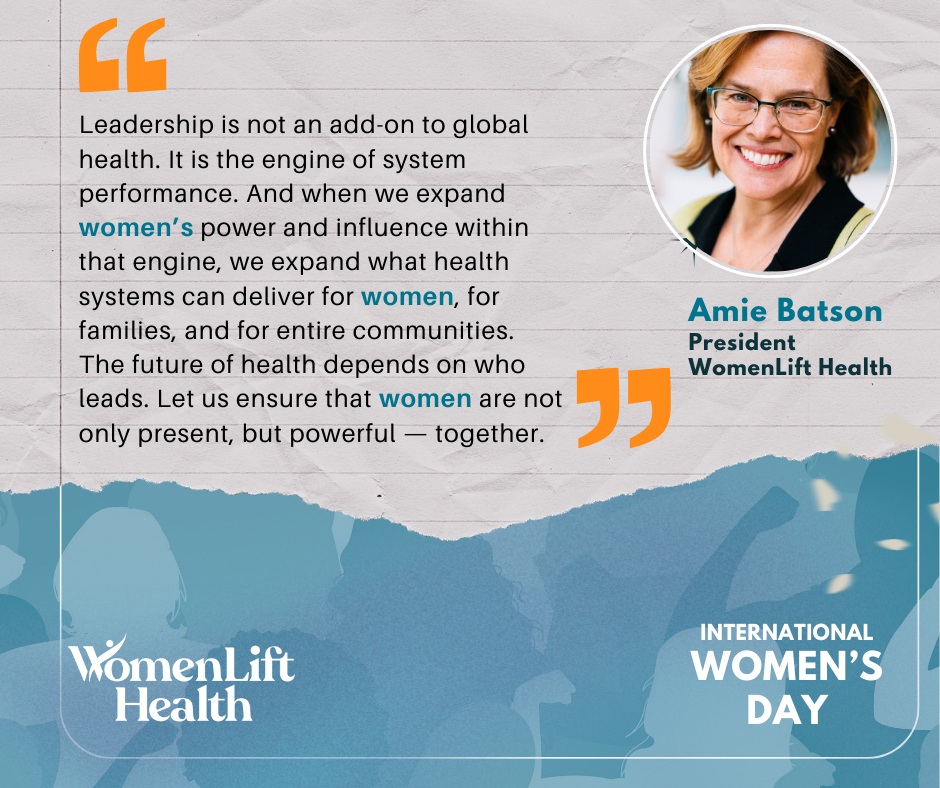
Leadership is not an add-on to global health. It is the engine of system performance. And when we expand women’s power and influence within that engine, we expand what health systems can deliver for women, for families, and for entire communities.
The future of health depends on who leads. Let us ensure that women are not only present, but powerful – together.