
Behind every maternal death averted and every newborn life saved is a workforce that makes those outcomes possible. Yet the people at the center of that work, midwives, remain one of the most undervalued and under-supported health workforces globally. Midwives stand at the threshold of life and death every day, often with inadequate supplies, fractured systems, and little political backing, the urgency does not follow a calendar or a campaign cycle. It is constant.
Global health advocates have called for one million more midwives. It is a striking number, and a necessary one. The global shortage currently sits at nearly 900,000 midwives, a gap that widened through the COVID-19 pandemic and has not recovered. According to the State of the World’s Midwifery 2021 report, the cost of that gap is not abstract: with one million more midwives, we could, by 2035, prevent 67% of maternal deaths, 64% of newborn deaths, and 65% of stillbirths, up to 4.3 million lives saved annually.
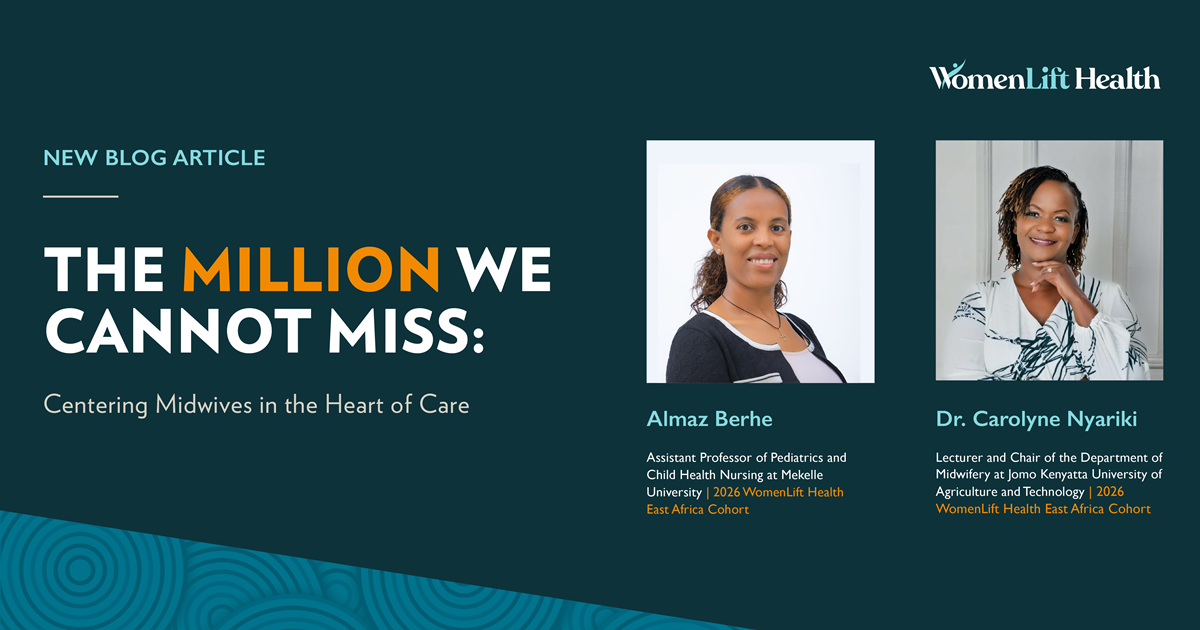
We sat down with two midwifery leaders, Almaz Berhe, Assistant Professor of Pediatrics and Child Health Nursing at Mekelle University, and Dr. Carolyne Nyariki, Lecturer and Chair of the Department of Midwifery at Jomo Kenyatta University of Agriculture and Technology, from our 2026 WomenlIft Health East Africa Leadership Journey to reflect on what that number truly demands and what it will take to achieve it.
More Than a Workforce Gap
The conversation around the shortage of midwives often remains numerical, how many midwives are trained, deployed, and retained. Both Almaz and Carolyne challenge this framing and not because the numbers are unimportant, but because they reveal only the surface of a deeper systemic problem.
For Carolyne, the structural problem in East Africa is one of design “In many East African countries, nurses are trained with midwifery competencies rather than as dedicated midwives,” she explains. “While this builds a versatile workforce, it often results in a lack of clear commitment to recruiting and deploying midwives specifically for maternal and newborn care.” Add migration of skilled personnel to higher-income countries, and the staffing gap becomes self-perpetuating.
Almaz frames the problem as one of the institutional belief. “Policy leaders must stop seeing midwives as a supporting workforce and start seeing them as the primary architects of family health,” she says. “When a leader truly believes in the midwife, not just as a birth attendant, but as a defender of women’s rights and a guardian of neonatal survival, the funding shifts from temporary support to essential investment.”
What Crisis Reveals
In Tigray, Ethiopia, the war made that gap catastrophic. Maternal mortality rose to 840 per 100,000 live births, a fivefold increase that Almaz describes as a total collapse of the health system. Health workers were direct victims of the conflict, yet what sustained care was not policy but adaptability. When hospitals were destroyed, midwives took their skills to the people, becoming, as Almaz puts it, a source of psychological security when all other infrastructure had failed.
Her work integrating GBV response and early childhood development into midwifery practice was not a programmatic choice; it was a response to what she witnessed firsthand, including supporting survivors of conflict-related sexual violence and helping ensure their experiences were heard.
It reshaped how she understands the role entirely: “A midwife cannot just look at a pregnancy; we must look at the trauma that precedes it and the child that follows it.” In any community with limited specialist access, the midwife is often the only continuous presence across pregnancy, birth, and early childhood. The question is whether systems resource reality or continue to treat it as a narrower role.
The Question of Leadership
Perhaps the sharpest convergence between Almaz and Caroline is leadership, specifically, on what it means for midwives to be excluded from the rooms where decisions are made.
Almaz is direct: “For too long, midwives have been the hands that execute decisions made by others who do not understand the intricacies of our clinical and social profession.” Her vision of leadership is not about titles. It is about the authority to act on what you know. “When midwives are in leadership, we can change protocols to match the reality of the ward, because we live that reality every day.”
Caroline approaches the same issue from her position as an educator. Preparing students to lead, not just to practice, means creating visibility early. She involves students in co-facilitating professional development sessions and research activities, building the kind of confidence that policy spaces demand. “These experiences help them develop communication, decision-making, and leadership skills early in their careers,” she says.
She is also frank about what it takes to be heard once you’re in the room. “Competence and confidence are essential. Resilience is equally important, as these spaces can be challenging and at times dismissive.” And to the midwife who does not yet see herself as belonging there: “You do. Your perspective is valuable. Your voice not only represents you, but the profession as a whole.”
The Evidence That Isn’t Moving Policy
Caroline’s research on obstetric triage offers a precise example of the gap between what midwives know and what systems have acted on. Triage is widely practiced but rarely structured. “There is a lack of standardized tools and clear guidelines, leading to delays in identifying high-risk cases and preventable deterioration in outcomes. Structured, integrated obstetric triage guidelines, she argues, would meaningfully reduce waiting times and improve maternal and newborn outcomes. It is a practical, implementable intervention that has not yet received the policy attention it deserves.”
This is a familiar pattern. Midwives hold clinical knowledge developed through direct experience with the very populations that policies are meant to serve. The obstacle is not evidence. It is the absence of midwives in spaces where evidence becomes policy.
What One Million Actually Means
The goal of one million more midwives is not wrong. But Almaz and Caroline together suggest that the number, on its own, is insufficient. What the world needs is not only more midwives but systems that treat midwives as what they are: primary providers, not support staff; leaders, not executors; experts, not auxiliaries.
A mother who is treated without dignity, Almaz notes, will not return to a hospital even for life-saving care. That is not an anecdote. It is a structural observation about what happens when the people closest to care are furthest from power.
The question is no longer whether the world needs one million more midwives. The question is whether we are willing to build the systems, policies, and leadership structures that allow those midwives to transform care.